


TOGETHER WITH ELEKEN

UI/UX blocking your SaaS growth?
Confusing design leads to churn, support overload, and lost conversions. Not because your product lacks value, but because users can’t reach it fast. We help turn your UI/UX into something intuitive, so your product delivers its full potential.
Please support our sponsors!

GEEK OUT
Touch Grass
I'm sitting on the sofa. My laptop is open. My kids are somewhere nearby. I can hear them, which I'm telling myself counts for something. My wife is doing the thing where she's not saying anything about the laptop but also very clearly noticing the laptop. I've been at my desk since 7am. It's now 9pm. I moved from the office to the sofa about an hour ago, which in my head qualifies as "finishing work for the day."
It doesn't, obviously. I know it doesn't because I've done this before. The slow drift from "I'm just going to check one thing" to realising you've been absent from your own evening. Your own weekend. Your own life, in the ways that actually matter.
I swore I'd never let it happen again. And here I am, on my sofa, laptop open, doing exactly the same thing in a different costume.
This time the excuse isn't the same as before. This time it’s AI.
I want to be clear about something before this piece goes where it's going: the AI tools we have right now are extraordinary. I f✱king love them. Every day I’m amazed by some new unlock. So this isn’t a doom piece. I'm not here to tell you that AI is bad and you should go live in a cabin.
I'm a product and growth advisor and a founder building DevTune. Not long ago, the things we’re doing across the business, the coding, the go-to-market, the content, the infrastructure, would have required a sizeable team. Now we can move at a speed that would have seemed absurd even twelve months ago. I can prototype something in a morning that used to take a week. I can go from idea to working feature in a single sitting. I can research a market, draft positioning, build a landing page, and ship it before lunch.
I've been in tech long enough to have sat through several hype cycles, and this one is different. The productivity gains are real, and they're compounding. If you're a builder right now, a founder, a developer, someone who makes things, you can do work today at a cadence that simply wasn't possible just months ago.
I don't take that for granted. I'm pretty sure I'm comfortably in the 99th percentile of people experimenting with and leveraging these tools. I use AI across every part of my business, every day. Writing code with agentic coding tools. Running multi-agent workflows for research and GTM. Building open source tooling that pushes what these systems can do. The opportunities this all opens up as someone building a business in 2026 is honestly insane, and I feel fortunate to be living through it all.
So I need you to hold that in your head, that I believe all of this, deeply, while I tell you what it's costing me.
Here's the thing about having superpowers: you want to use them. All the time. There's always another experiment to run, another feature to build, another angle to explore. And because the tools are so good, the gap between "I wonder if..." and "let me just quickly..." is now near zero.
So you do. You try the thing. Again and again and again.
The FOMO is unlike anything I've experienced, and I've worked in tech for a long time. Every day on X, on LinkedIn, someone is shipping something extraordinary that they built in a weekend. Someone is sharing a workflow that makes yours look primitive. Someone is launching a product that sounds like the thing you were going to build next week. The rational part of your brain knows that most of this is noise, that you're already ahead of the curve, that no human being can absorb and act on everything. But the irrational part, the part that drives most founders, doesn't care about rational.
I'm writing this from the perspective of a founder, because that's the life I’m living as all this unfolds. But I've had enough conversations with PMs, marketers, and DevRel folks to know this isn't just a founder problem.
The tools don't care what your job title is.
If you're in tech and you build, ship, or create things, you're feeling some version of this.
That being said, for me, the FOMO isn't really about other people. It's about unrealised potential. The growth PM inside me can't stand the idea of leaving experiments unrun. Failing is fine. Failure is just learning. But failing because I didn't try everything I could have tried? That's one of the things that keeps me on the sofa with my laptop at 2am.
And underneath all of it, there's this feeling that I've struggled to name. It's not burnout. I'm not crashing. It's not overwhelm. I'm still functioning, still shipping, still moving forward. In fact I’m still buzzing about what’s possible. Still excited.
It's something more subtle. A low-grade hum of unease that never quite switches off. A bubbling level of stress that sits just below the surface. You're always edging it. Never quite tipping over, but never at rest either. And because you're still productive, still delivering, you don't flag it. You don't even give yourself permission to flag it. You just keep going.
That's not a healthy place to be. I know this. And yet….
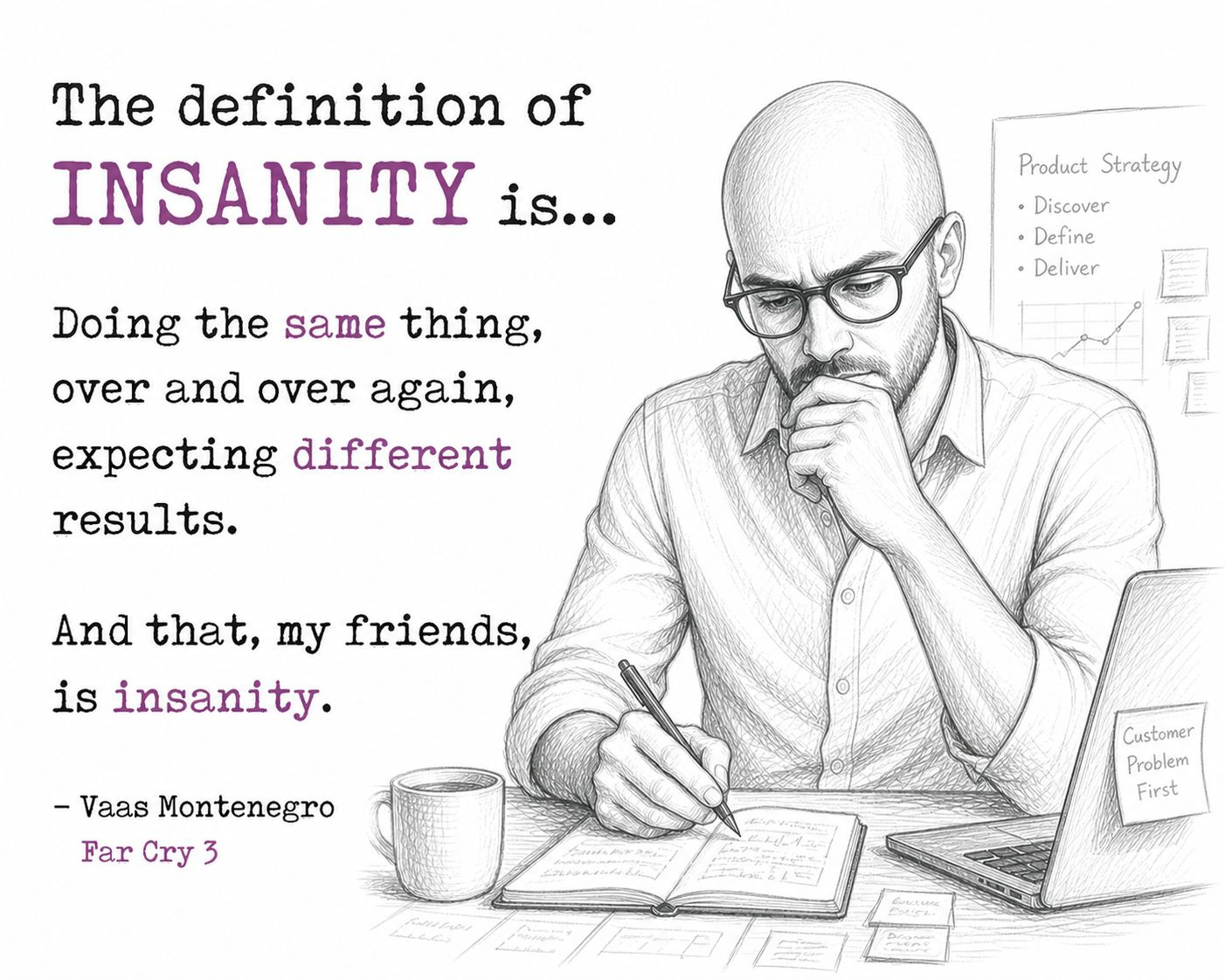
I've lived this before. Different setting, same pattern.
For years I was in senior leadership and exec roles at companies like CloudBees and Snyk. I flew constantly. I was in a different city every week, usually a different country. Early flights, late dinners, hotel rooms that all looked the same. There was a buzz to it. Peak startup bubble. ‘High-performing teams’. Driving each other on, the energy of building something that mattered. I loved it, honestly. And I told myself, over and over, that I was doing it for my family. Building a career, earning well, providing. And there was some truth in that.
But there was also a version of events where my kids were growing up and I was somewhere else. Where bedtimes happened without me more often than with me. Where the small, unremarkable moments, the ones that only become important in hindsight, just quietly passed by while I was in an airport lounge telling myself it would all be worth it.
When I stepped away from that life, I made a promise to myself. I wouldn't let it happen again. I'd be present. I'd be there.
And now I am there. I work from home. I'm in the same building as my kids almost every day. And I'm doing the exact same thing.
The difference is that this time, the gap is pernicious. When you're travelling, the absence is obvious. You're not there. Everyone knows it, including you. But when you're on the sofa, laptop open, technically in the same room, you can tell yourself you're present. You're not. You're physically home and mentally somewhere else entirely. And honestly, that’s worse, because at least when I was flying to San Francisco, Boston, or Raleigh, nobody was pretending I was available.
The justification has changed, but squint and it’s the same pattern.
There's a cognitive cost to all of this that I don't think we talk about enough. The density of what I'm absorbing and producing on any given day is extraordinary. I'm context-switching between code, copy, strategy, infrastructure, customer conversations, open source projects, and the AI tools mean I can make meaningful progress on all of them in a single day. That sounds like a good thing, and in many ways it is. But my brain hasn't upgraded alongside the tooling. It's the same brain it's always been. Damn you AuDHD.
And that brings me to the title of this post and the phrase that won't leave my head: touch grass.
Internet slang for "you're too online, go outside." But beyond the dig, there's something important buried in it.
The literal version first. Getting outside, away from screens, into open air. It's a basic need that we've started treating as optional. I've kept a daily walk habit for the last couple of years. An hour ideally, at least thirty minutes. It's the time where I process things. Where the background threads in my head actually get to run. Where the half-formed idea from the morning becomes a clear thought by the afternoon. Where the stress settles, just enough, to let me think straight.
That habit has been gradually eroding. It seems to correlate pretty directly with how much more capable the tools have become. There's always one more thing to do before I head out. One more thing turns into three. The walk gets shorter, then gets pushed to later, then doesn't happen. And I don't notice until I've gone a week without proper time away from a screen and I feel like my head is full of static.
I don't think that's an accident. When the thing that keeps you sane is the first thing you sacrifice to the work, something has gone wrong. You're not processing anymore. You're just accumulating, and none of it is getting the space it needs to settle.
When I walk, things change in an important way: the hum quiets down. The constant noise I carry around all day, the half-finished thoughts, the next thing on the list, the background anxiety about everything I haven't done yet, it doesn't disappear, but it drops to a level where I can actually think and process.
We're not built to stare at screens for sixteen hours a day. We know this. Everyone knows this. And yet when the screens are showing us things we're excited about, things we're building, things that feel urgent and important, we act like the rules don't apply. But they do apply, even if your brain is pretending otherwise.
But touch grass means something beyond the literal, too. It means reconnecting with the things that make us human in ways that have nothing to do with output. Spending time with people you love, not while half-looking at your phone checking in on your background agents, but actually being there. Belonging. The kind you can't get from a Slack channel or a Twitter thread. Caring for people. Being cared for. The stuff you know matters but deprioritise anyway when the work feels important enough.
My kids are still young. Nine and seven. These years don't come back. I know this because I already lost some of them to the last version of this pattern. The exec version. And the fact that I can see myself doing it again, that I can catch myself on the sofa at 10pm, laptop open, kids in bed, wife quiet in a way that means something, that awareness has to count for something. But only if I actually do something with it.
I'd love to be able to wrap this up with a framework. Five steps to reclaiming your life from AI-powered productivity. A neat before-and-after. A morning routine that fixed everything.
I don't have that. (Sorry!)
What I have is awareness. I can see the pattern. I've seen it before, lived through it, come out the other side with enough regret to know I don't want to do it again. And I can see myself doing it again. That tension, between knowing better and doing the same thing anyway, is where I'm living right now.
So I’m writing this post partly as an accountability lever.
I'm going to get the walk back. Every day, an hour ideally, thirty minutes minimum. My head needs space and the walk is where I’ll find it.
I'm going to set clearer boundaries between work and home. That's hard when you work a lot from home and your brain never fully leaves the business. I'm negotiating this with myself, negotiating it with my family, and I don't have it fully figured out. I’m falling short of what I'd like. But that’s going to change.
I have to accept that I'm not going to run every experiment, ship every idea, explore every possibility. That some potential will go unrealised, and that has to be okay.
I think the most important thing, maybe the only thing I'm actually sure of, is that being conscious of this matters. Accepting that you're flawed, that this technology can push you into patterns you've seen before, that you're not immune just because you're aware. That's not a fix. But it's where fixing things starts.
So if any of this sounds familiar, if you're reading this on your phone on the sofa while your family is in the next room, maybe close the laptop tonight. Go for a walk tomorrow. Touch grass. Not because it fixes everything, but because you're a human being, and human beings need more than output.
You already know this. I already know this. The hard part is doing it.
BEFORE YOU GO
Book a free 1:1 consultation call with me - I keep a handful of slots open each week for founders and product growth leaders to explore working together and get some free advice along the way. Book a call.
View your free public Dev Tool AI Market Presence Report - 480+ dev tools across 42+ verticals and growing, all in the Dev Tool AI Search Landscape.
Sponsor this newsletter - Reach over 8000 founders, leaders and operators working in product and growth at some of the world’s best tech companies including Paypal, Adobe, Canva, Miro, Amplitude, Google, Meta, Tailscale, Twilio and Salesforce.
PS: Thanks again to our sponsor: Eleken