

3 essential ingredients for PLG success
And why user centricity isn’t enough to win


It’s surprisingly common for product and growth teams working in B2B PLG to over rotate in their focus on the user.
This bias isn’t a bad thing per se - you’ve heard me rabbit on lots in the past about needing a relentless focus on serving the end user to be successful in PLG.
And that’s true, but it's true in the context of the traditional sales-led approach, which biases to the other end of the spectrum to prioritise serving the buyer.

Product-Led Growth demands serving end users exceptionally well.
Sales-Led Growth demands serving buyers exceptionally well.
Product-Led Sales demands bridging the gap to serve both buyers and users exceptionally well.
But while useful, this is a one dimensional perspective.
It ignores a critical dynamic in B2B.
The team.
In this post I’ll explain why a focus on teams and accounts is essential to underpin a winning PLG strategy, and share the three common characteristics shared by the best PLG companies
Prosumer B2B
In prosumer scenarios, a one dimensional focus is fine.
Prosumer implies single player.
An individual is hiring you to help them solve a problem they have.
It’s most akin to B2C.
It’s still B2B, because the problem you’re helping them solve is faced by individuals in their business context.
Prosumer is a portmanteau of the words ‘Professional’ and ‘Consumer’.
If you successfully help those individuals solve that problem, then you can sell to them.
User = Buyer.
If the problem(s) you help solve aren’t ones that are also faced by people working together in their business, then you don’t need to think beyond this - but your business will be constrained in the amount you can charge.
If you want to grow beyond those constraints, you need to find more valuable problems to solve, where value is determined by willingness to pay more.
And that means solving team or company level problems.
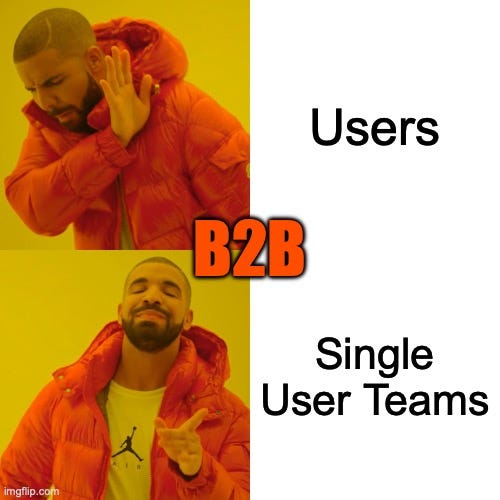
Real B2B is multiplayer co-op
While solving business problems for individuals is technically still B2B, if there’s no path to team and company usage, I consider it to be closer to B2C.
Real B2B helps solve multiplayer problems.
The bigger the problem you help solve, the more you can charge.
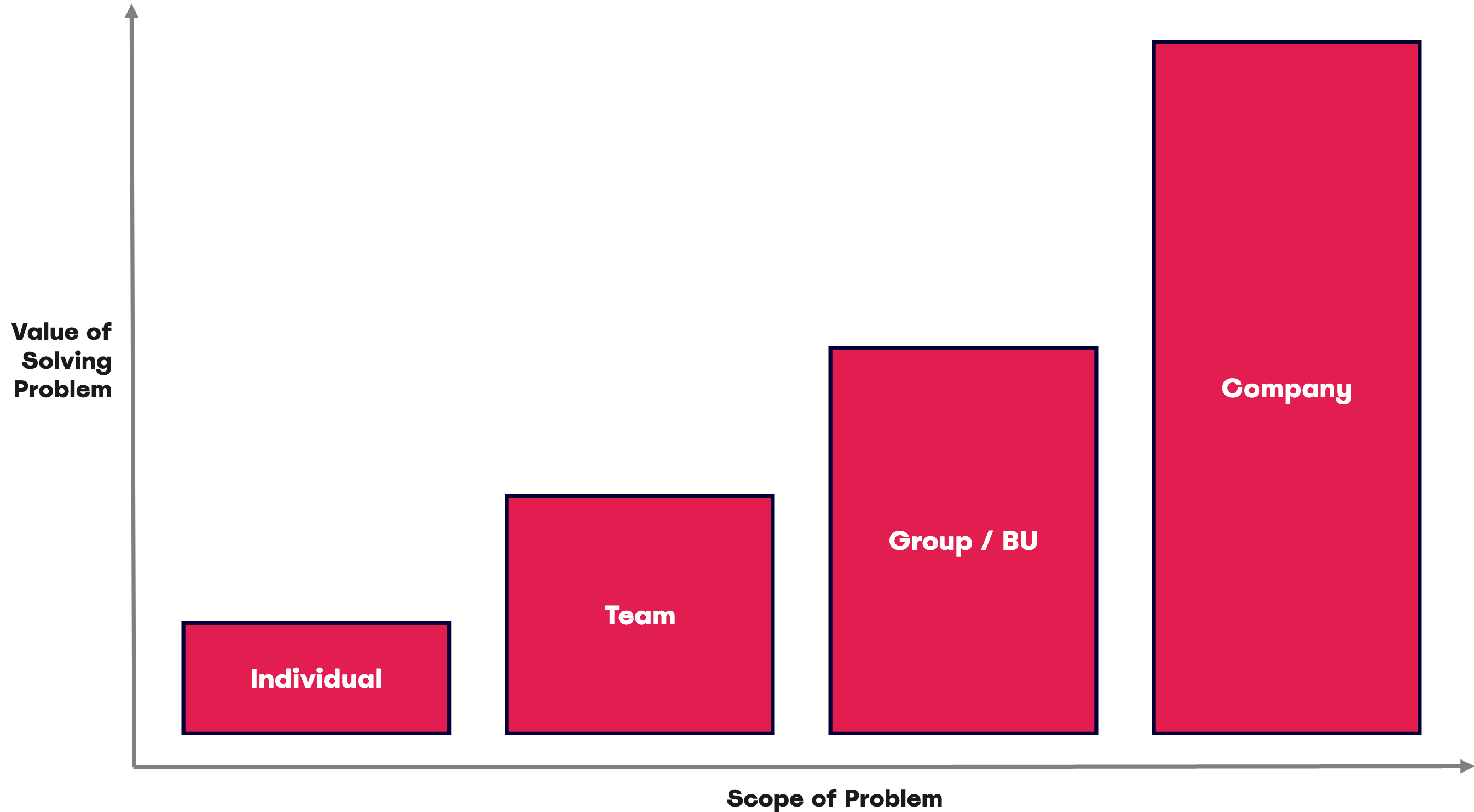
To win in B2B PLG, you need to go beyond the one dimensional perspective of serving the end user exceptionally well.
In B2B, your users are people who are working together in a team.
Every user action happens in the context of a team, workspace, company, or account.
Notion: users create dynamic documents; they and others in their team/company view and collaboratively update them.
Slack: users send messages, and others in their team/company read them and reply.
Loom: users send videos (Looms), and others in their team/company view them, react and comment.
Jira: users create tickets, and they disappear into the ether 👀
Serving end users exceptionally well is tablestakes.
It remains critically important, but it's not enough.
Three essential ingredients for PLG success
The most successful B2B PLG companies have three key characteristics in common:
A product that effectively solves higher value problems
The ability to effectively communicate the value of the product to the right people at the right time
The ability to effectively mitigate blockers to adoption of higher value
Note the emphasis on ‘effectively’ - this is really important, and I’ll focus on it as I elaborate on each of those three ingredients.
1. Effectively solve higher value problems
There are two parts to this.
Functionality
The first, and most obvious, is that your product functionality must address the needs of (i.e. provide value to) the people working together across the spectrum of increasing problem scope.
If your product only solves a problem that individuals care about then you have a hard ceiling there.
If your product solves a problem that teams have but doesn’t provide the type of organisation, reporting and governance capabilities that are needed in group / team-of-teams scenarios, then that’s your ceiling.
And so on.
User (Team) Experience
The second is that your product’s UX must allow users to access that value. This means onboarding and intentional and thoughtful core product design that acknowledges and caters for both multiplayer usage and scale.
Take onboarding as an example.
Most B2B teams working on onboarding lose sight of this one core principle.
In multiplayer B2B you have to consider both
first user onboarding
n'th user onboarding
Their experiences should typically differ.
Often (and more commonly in products with more involved/complex setup) different individuals in a team take on different roles in the activation journey.
You should aim to craft individual onboarding experiences that are designed to get the team to a point where they have realised some value and are starting to build habits around using the product.
In other words, build experiences for individual users that help them achieve their team goals.
Do that well, and the team will retain better, and be more likely to buy from you.
2. Effectively communicate value
Even if we effectively solve higher value problems, growth can be artificially capped if you’re unable to:
make people aware that you solve higher value problems
convince them that you solve those problems well
With lower scopes of problem, your product can often do most of the heavy lifting.
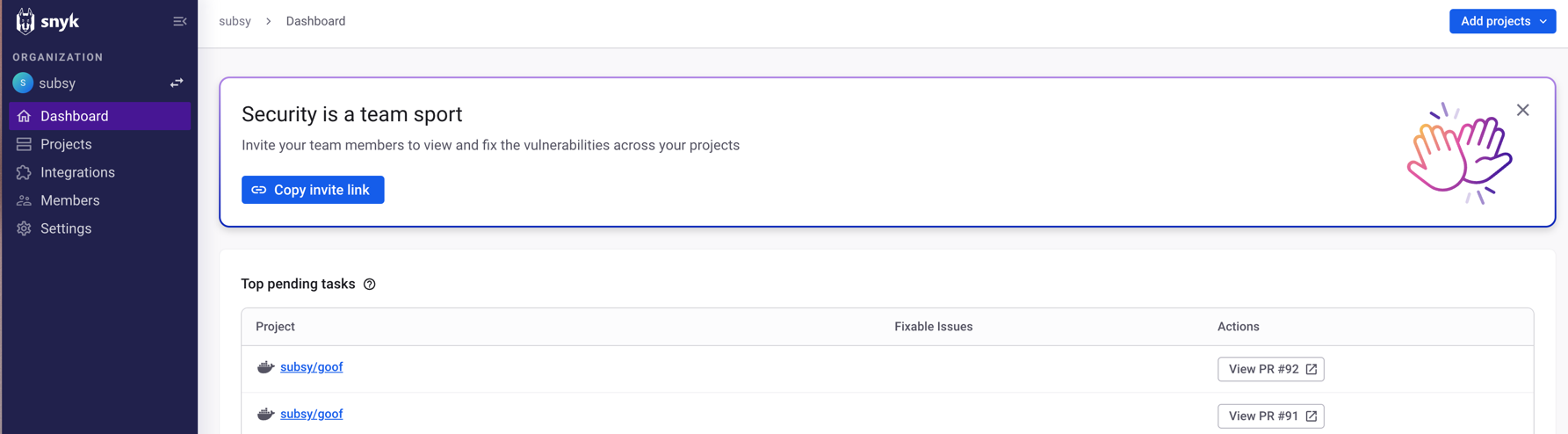
Individual users can be made aware of the additional higher-level value of inviting others to collaborate with them.
Ideally there’s a win-win - there’s benefit to the team in better achieving their goals, and the individual user benefits as a result.
Google Docs: The team can more quickly review and iterate on a document. I no longer have to deal with the hassle of sending docs around on email and triaging async threaded comments.
Snyk: The team can see and manage our appsec backlog in a single place and focus on the most important issues. I no longer need to spend so much time in security reviews.
But there’s a limit.
The product’s ability to effectively communicate value to the right people at the right time diminishes as the scope of problem increases.
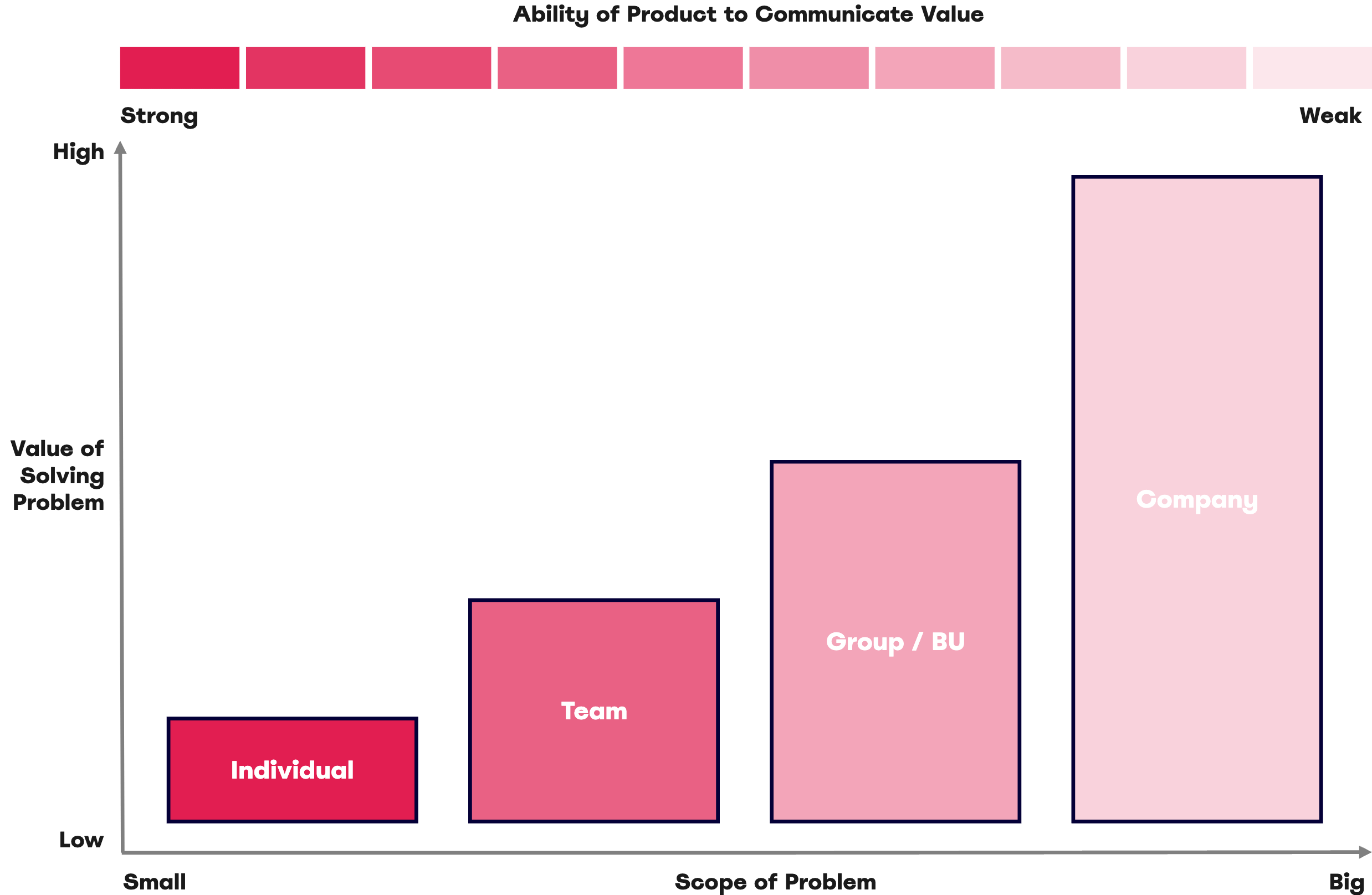
For example, the Snyk product can’t effectively tell the story of the value of company wide adoption being reduced risk of financial and reputational damage.
And that’s where humans come into the picture to augment the work of the product in demonstrating user and team value.
Humans (Product Specialists, CS, Account Execs, …) can craft a compelling narrative that effectively sells the value of group and company level adoption in ways the product itself cannot.
This is often - but not always - also accompanied by a change in buying dynamic where the buyer persona is no longer a user of the product.
At Snyk, when companies reached a certain size the ownership of security initiatives moves away from engineering teams and is typically centralised under a security function, and it became much less likely that someone with buying responsibility was part of the user base.
So there’s three parts to this.
The message, who the message targets, and how the message is delivered.
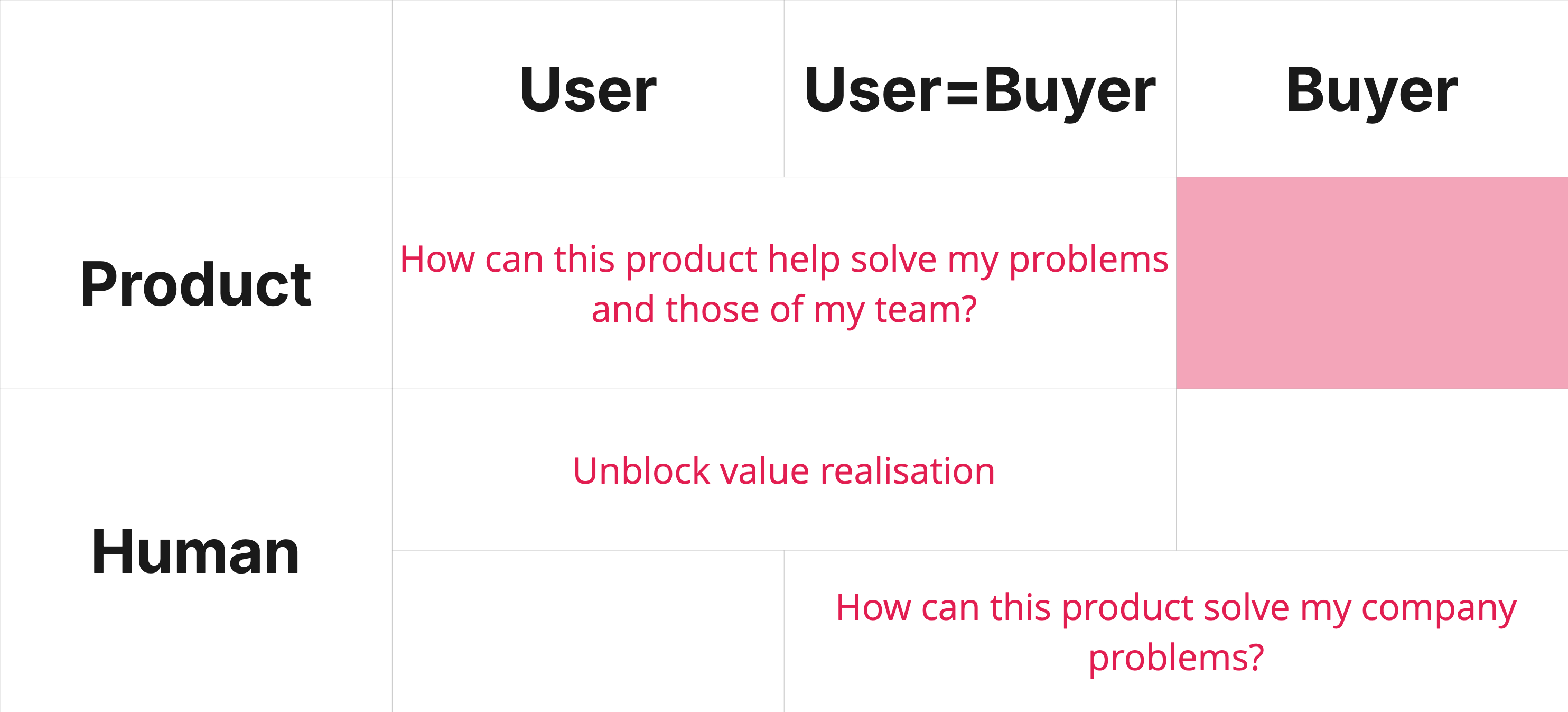
You’ll use apply monetisation awareness in product and via out-of-product notification channels to communicate the value of the product in solving individual and team-level problems.
And you’ll leverage ABM, CS and product-led sales engagement to communicate company-level value.
In ICP accounts you’ll also lean on product specialist / sales-assist type roles to help ensure the product value promise is delivered, because even if you’re telling a great story about company-level value, if the users and teams in the product aren’t unlocking the value you’ve promised, you won’t be able to monetise.
3. Effectively mitigate blockers
Even if you effectively solve higher value problems, and you effectively communicate value to the right people at the right time, growth can be artificially capped if you’re unable to mitigate blockers to wider adoption and monetisation.
In the excellent PLG course at Reforge, the concept of the monetisation escalator is introduced.
The aim is to escalate adoption and monetisation from the entry point all the way up to your highest revenue (highest value) offer.
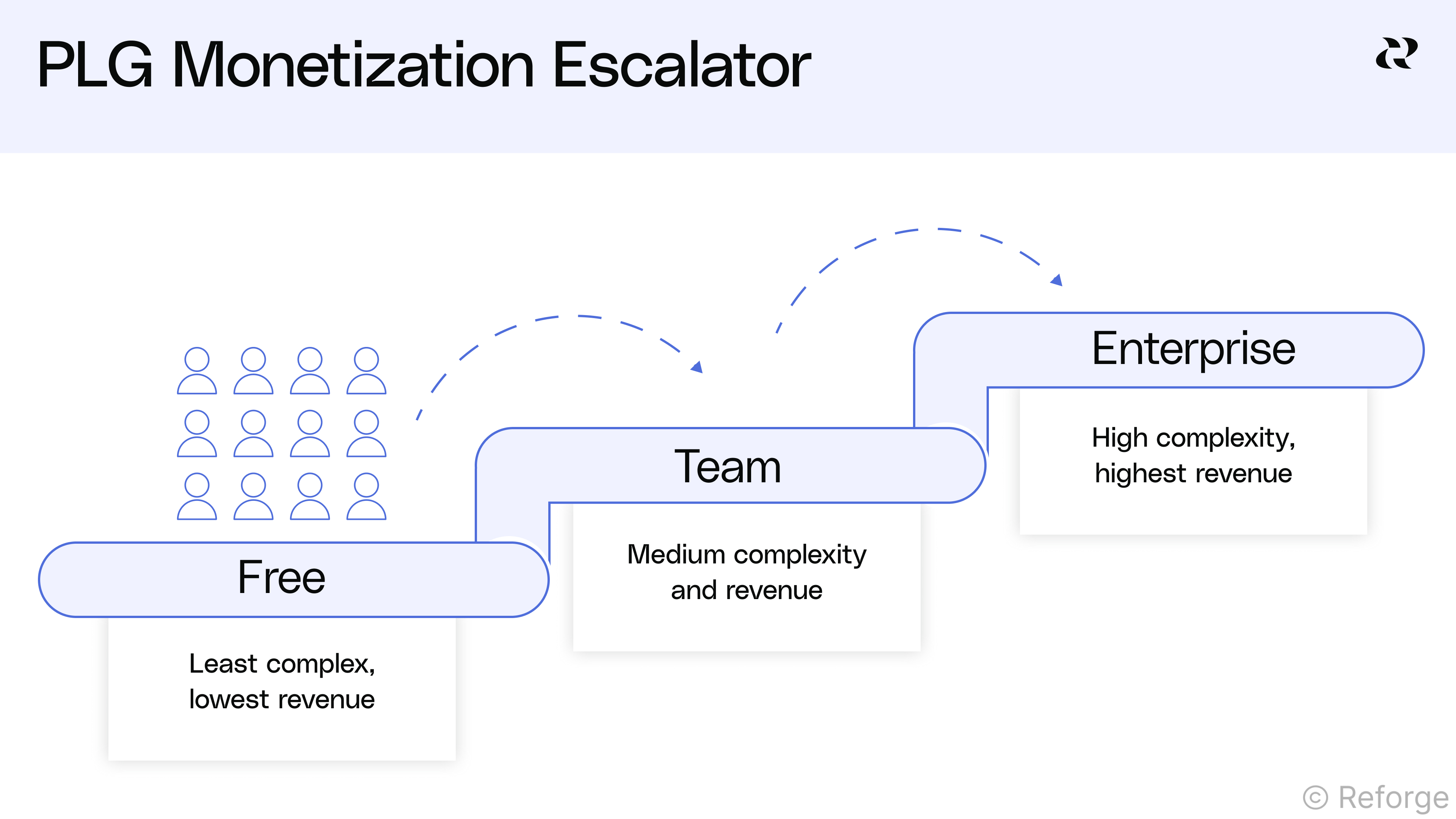
In the visual here three steps exist but you product and business may have more (sometimes but rarely less).
The monetisation escalator mirrors the value / scope of problem steps chart.
You will find that there are blockers that exist that prevent escalation from one step to the next.
You need to identify those blockers and find ways to mitigate them.
Here’s a snapshot of blockers identified at Snyk:
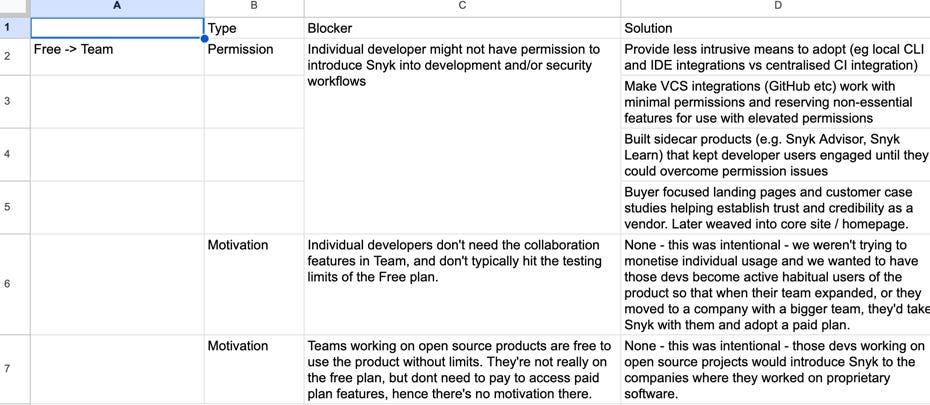
It’s beyond the scope of this post to go into this in detail, but blockers can be in the categories of motivation, ability, or permission.
I highly recommend checking out the Reforge PLG course to dig deep on this topic.
You might also catch me as a featured guest if you take one of the live cohorts!
Summary: It’s a mindset
The most successful B2B PLG companies have three essential ingredients:
A product that effectively solves higher value problems
The ability to effectively communicate the value of the product to the right people at the right time
The ability to effectively mitigate blockers to adoption of higher value
And to make those things work well, you must go beyond just serving users exceptionally well.
You need to weave team and account-level thinking into everything you do, from your monetisation strategy, to your messaging, to your onboarding and new user experience, to how you analyse product usage data, to your metric definitions, to your product state model, to the way you approach product-led sales (hint: use PQAs) and more.
Until next time!
This post was presented by Zeda.io.
Great way to start Tuesday. Thanks Ben