



Your AI go-to-market stack has a missing data layer.
Connect Claude, ChatGPT, Glean, or any AI agent to live second-party data with Crossbeam’s MCP Server: account overlaps, co-sell signals, and partner-shared account intelligence you can't get anywhere else.
Find out what your partner network already knows about your target accounts and open deals.
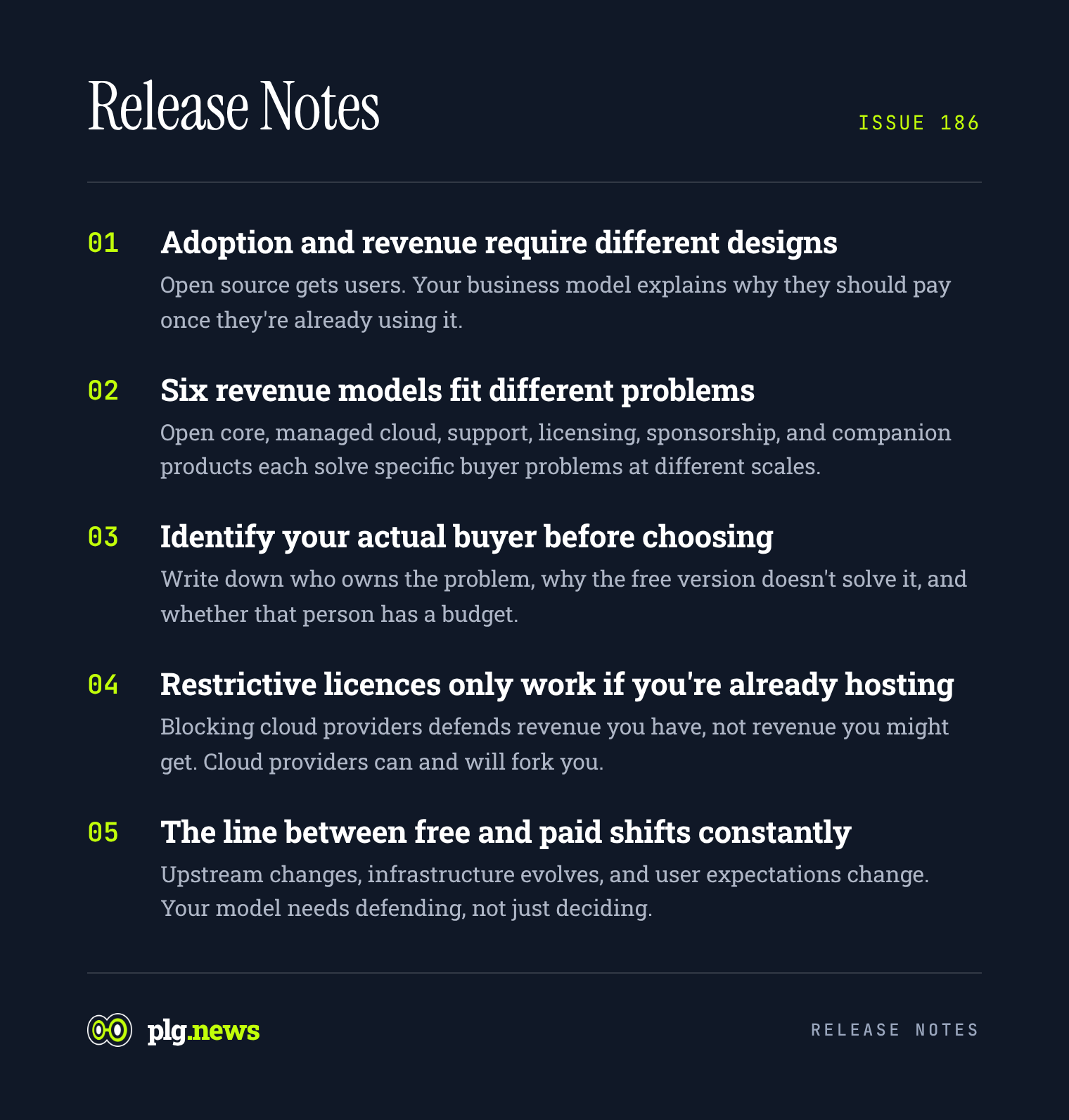
Open source lets someone use your product without paying for it. It can be an amazing growth lever, but only if your business model can explain why paying for it makes sense regardless.
The question you need to be able to clearly answer is what becomes valuable enough to pay for once someone is using the software?
For some products, it’s hosting and operating it. For others, it’s controlling access, meeting compliance requirements, or getting timely support for any issues they might bump into. There’s no one size fits all.
TL;DR - the six models, and who each one is actually for:
Open core - the individual adopts, then their company pays to govern.
Managed cloud - you’re on call.
Support and services - you sell expertise and an SLA.
Commercial licensing - you sell different terms permitting specific use-cases
Sponsorship - you ask someone to fund work everyone benefits from.
Companion products - you sell a second thing to people who already love the first.
Often companies end up running two or three.
Open core: the individual adopts, the organisation pays
With open core, the base product is open source and customers pay for additional proprietary capabilities.
GitLab: Premium and Ultimate capabilities for team workflows, security, and governance.
Grafana: Enterprise data-source plugins, reporting, and additional access controls.
Metabase: Advanced permissions, enterprise authentication, and embedded analytics capabilities.
The free product has to solve a complete problem for a user. They should be able to adopt it, use it seriously, and ideally recommend it to their peers.
Then when more people inside the company start using it additional requirements start to surface. Permissions. Approval workflows. Audit trail. SSO. Organisations have different requirements to end users.
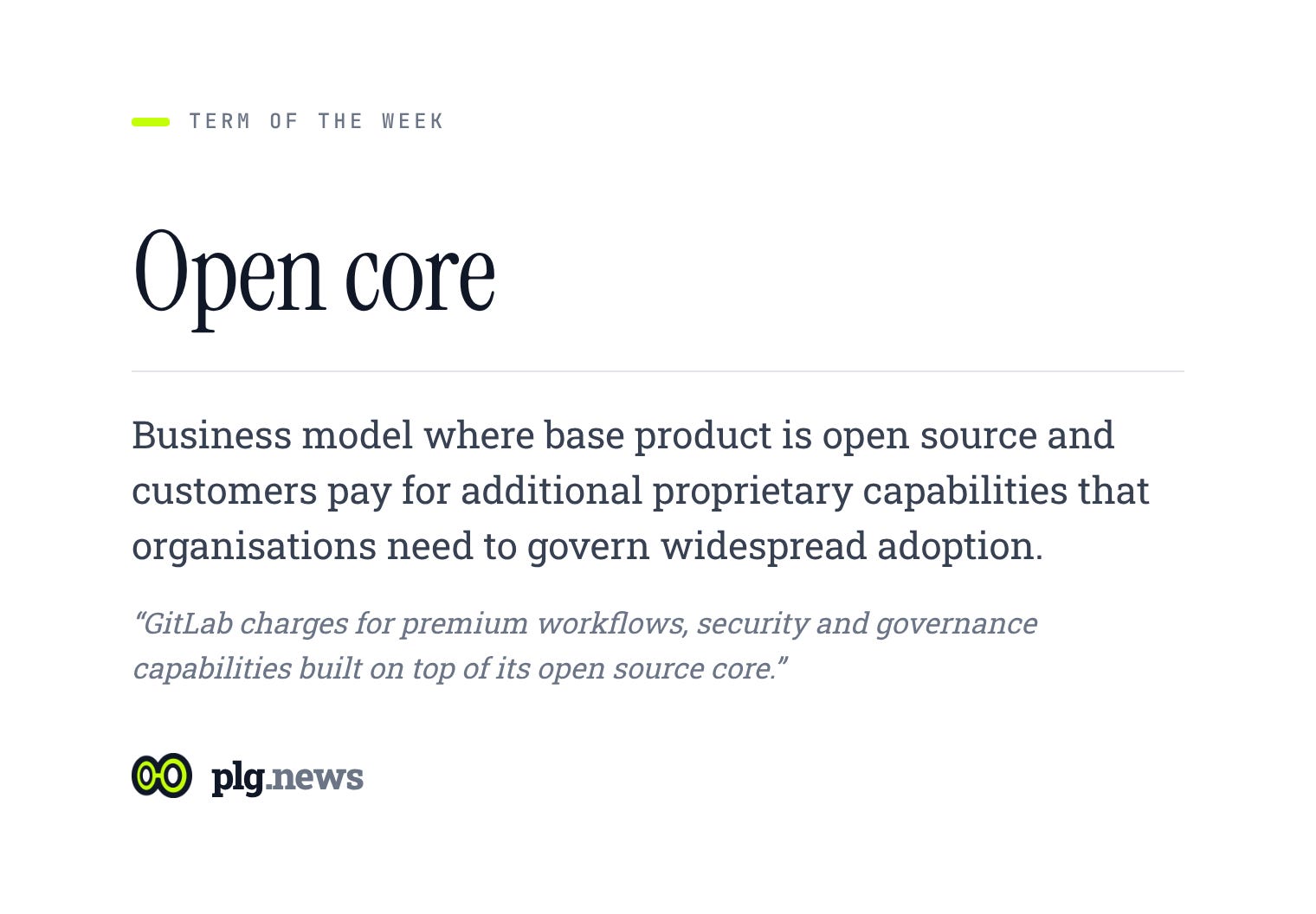
The paid boundary is where your product gets useful enough that a team needs to govern it.
It’s a tricky balancing act to choose which features sit on which side. Paywall something people need for ordinary use and they’re less likely to try it. Give away everything a paying org needs and they’re less likely to pay.
I lived this at CloudBees. Our core commercial offer was Enterprise Jenkins, and over the years open source Jenkins plus the infrastructure layer around it (Kubernetes, mostly) steadily eroded the value we were charging for.
Beware though, moving the line is a one-way door. Adding new paid capabilities is easy. Making previously free capabilities paid is not.
Take MinIO. A release in May 2025 stripped the admin console out of the community edition.
The GitHub discussion that followed was titled “It’s not a feature issue, it’s a trust one”, and that diagnosis was correct. Users forked the console themselves, others packed up and moved to alternatives.
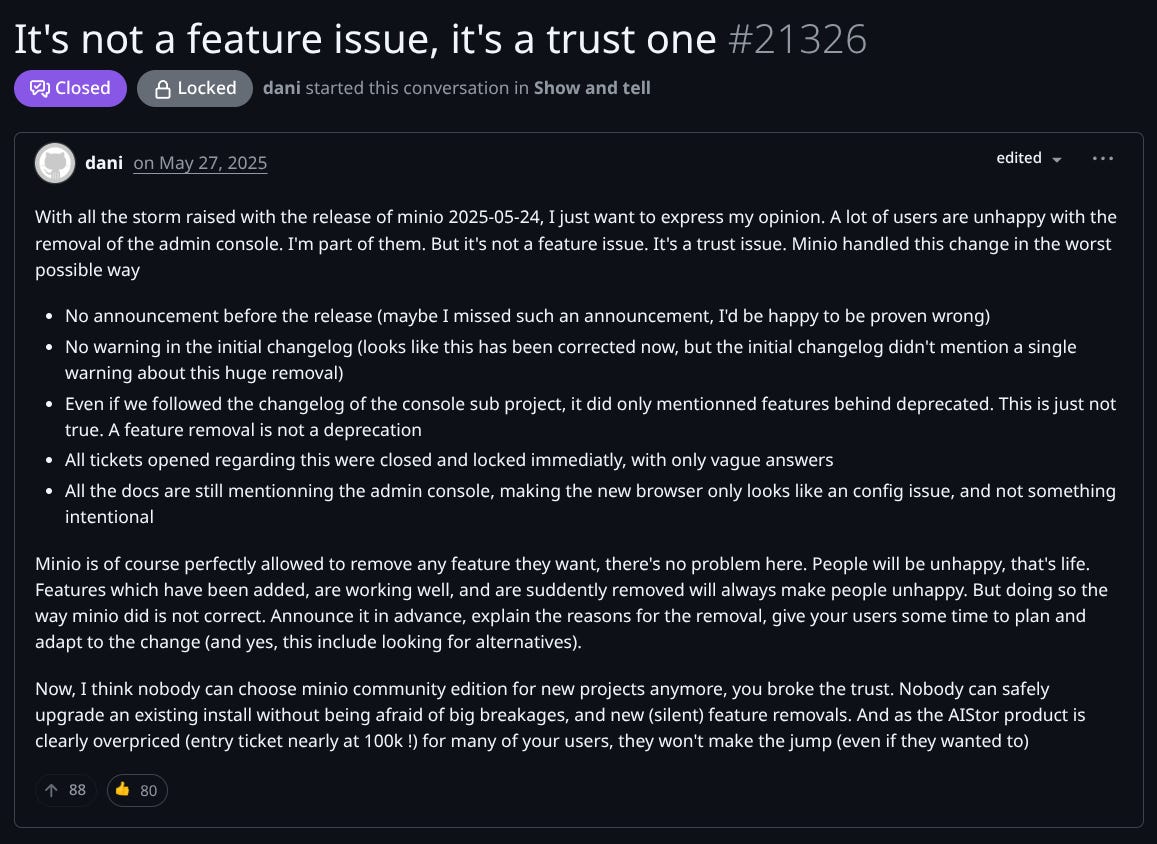
By December 2025 a co-founder had pushed a commit declaring maintenance mode, and the repo was archived in February 2026, briefly unarchived, then archived again in April. The README now points people at AIStor.
The lesson is to decide where the line goes before people build on the wrong side of it.
Managed cloud / hosting
With managed cloud, you run the software for the customer and charge for it.
Supabase: A hosted backend with managed infrastructure and additional platform capabilities.
Grafana Cloud: Managed observability services for metrics and visualisation.
Temporal Cloud: A managed Temporal service, billed through plans and usage.
You can self-host Supabase, but then provisioning, updates, database maintenance, backups, recovery, and uptime become your responsibility. The documentation highlights the differences:
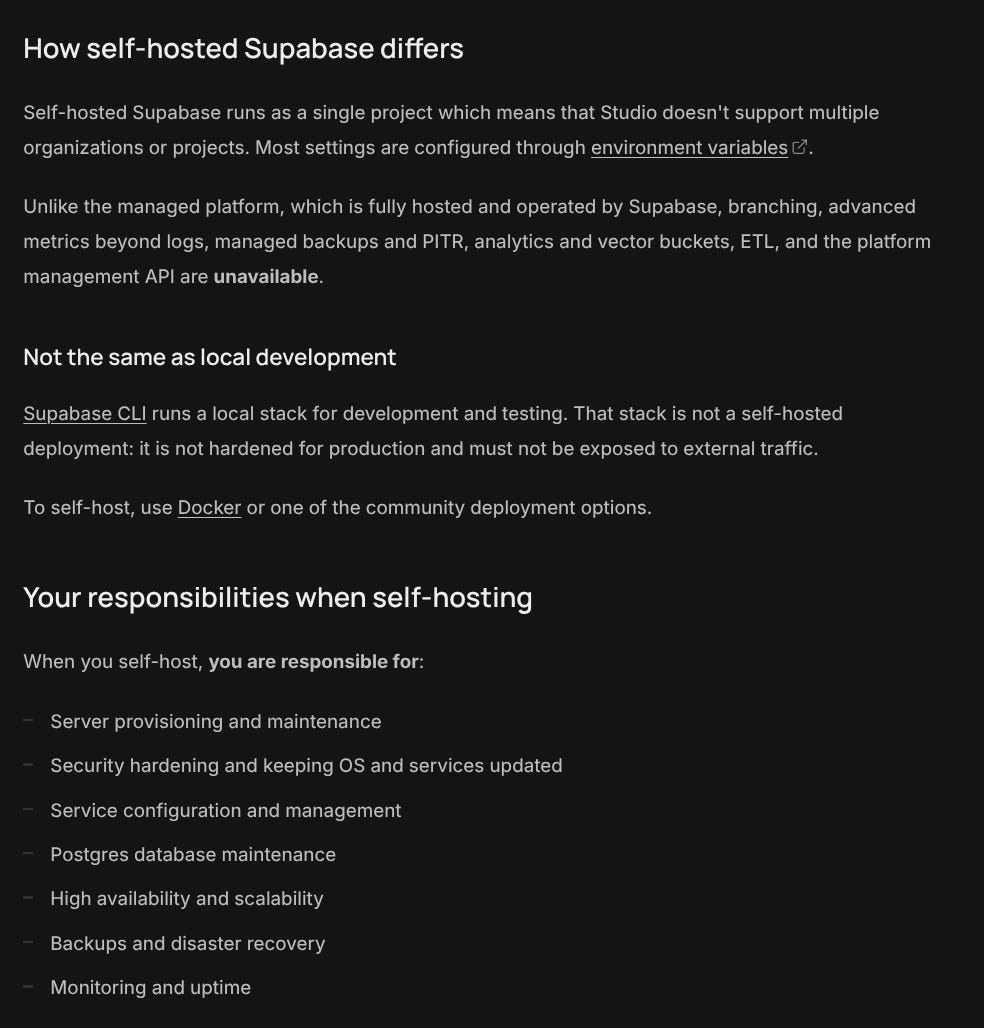
Installation is rarely the issue. But someone needs to be on the hook to own ongoing maintenance.
That ongoing responsibility is why databases, queues, and streaming systems suit this model so well. The work continues after setup, and typically becomes more demanding as usage grows. (which is a pretty convenient monetisation lever!)
If this feels like a relevant model, list the jobs the customer would otherwise have to do themselves. Then work out whether they want to pay you to take that responsibility off their hands.
Support and services
Here you sell access to expertise and a defined commitment to help.
Red Hat: Tested enterprise software, lifecycle maintenance, updates, and support.
Percona: Specialist support for open-source databases, including MySQL and PostgreSQL.
SQLite: Paid maintenance advice and priority support from SQLite’s developers.
Red Hat isn’t really selling software. It’s selling a credible answer to “how will this infrastructure be maintained over the next decade”, which is a question that keeps a particular kind of buyer awake at night.
The catch is, if every customer needs a bespoke engagement, growing revenue means adding more people.
Commercial licensing
Two different decisions tend to get bundled together here.
Dual licensing offers the software under alternative terms. A customer pays for a commercial licence when the open-source obligations don’t fit how they want to distribute or integrate it.
Source-available restrictions instead limit particular uses, typically running a competing hosted service.
One precondition. To sell commercial terms you need the right to relicense every line, which usually means a CLA (Contributor License Agreement) giving you permission to do so. Projects that took copyleft contributions without an agreement are stuck unless they can get everyone to agree after the fact.
Qt: Open-source and commercial options (Paid terms for customers whose requirements don’t fit the applicable GPL/LGPL obligations.)
MySQL: GPL and commercial licensing (Commercial terms for OEMs and vendors distributing proprietary products.)
Confluent: Source-available terms for certain components (Restrictions on competing hosted offerings alongside paid enterprise products and cloud services.)
The devil is in the detail of course. Qt’s LGPL terms can permit closed applications when the requirements are met, so “closed product means you must pay” is too broad. Confluent’s restrictions apply to specific Confluent components; Apache Kafka remains Apache-licensed.
Who the restrictions are actually aimed at
Source-available terms show up in the same situation nearly every time. The project is infrastructure, a cloud provider is running it as a managed service at scale, and the company maintaining it sells a competing managed service. The licence is a wall around the hosting business.
MongoDB went first, in 2018. Confluent followed weeks later. Elastic changed its licence in early 2021, after years of fighting AWS over its hosted Elasticsearch service and the use of the name. Redis did the same in March 2024.
Each time, the same thing happened next. Someone forked the last open version and kept building it. AWS turned Elasticsearch into OpenSearch. Eight days after the Redis announcement, the Linux Foundation launched Valkey, with AWS, Google, Oracle, Ericsson and Snap behind it. HashiCorp got OpenTofu.
Both Elastic and Redis have since added an open source licence back alongside the restrictive ones. Elastic did it in 2024 and said the original change had worked. Redis did it in 2025, admitted it had damaged its relationship with the community, and also said the change had done its job.
OpenSearch and Valkey are both still going.
Elastic’s account and Redis’s account are both interesting spins reads.
Sponsorship
Sponsorship funds the continued work of a maintainer or project. Usually that’s in exchange for publicity in some form, but that’s rarely the driver. The real reason most companies sponsor OSS projects is that they depend on them, and so have a vested interest in ensuring their continued development and longevity.
Vue.js: Individual and corporate sponsorship, with recognition benefits at different tiers.
ESLint: Donations through Open Collective and GitHub Sponsors fund maintenance and development.
webpack: Recurring backer and sponsor contributions, plus one-off donations.
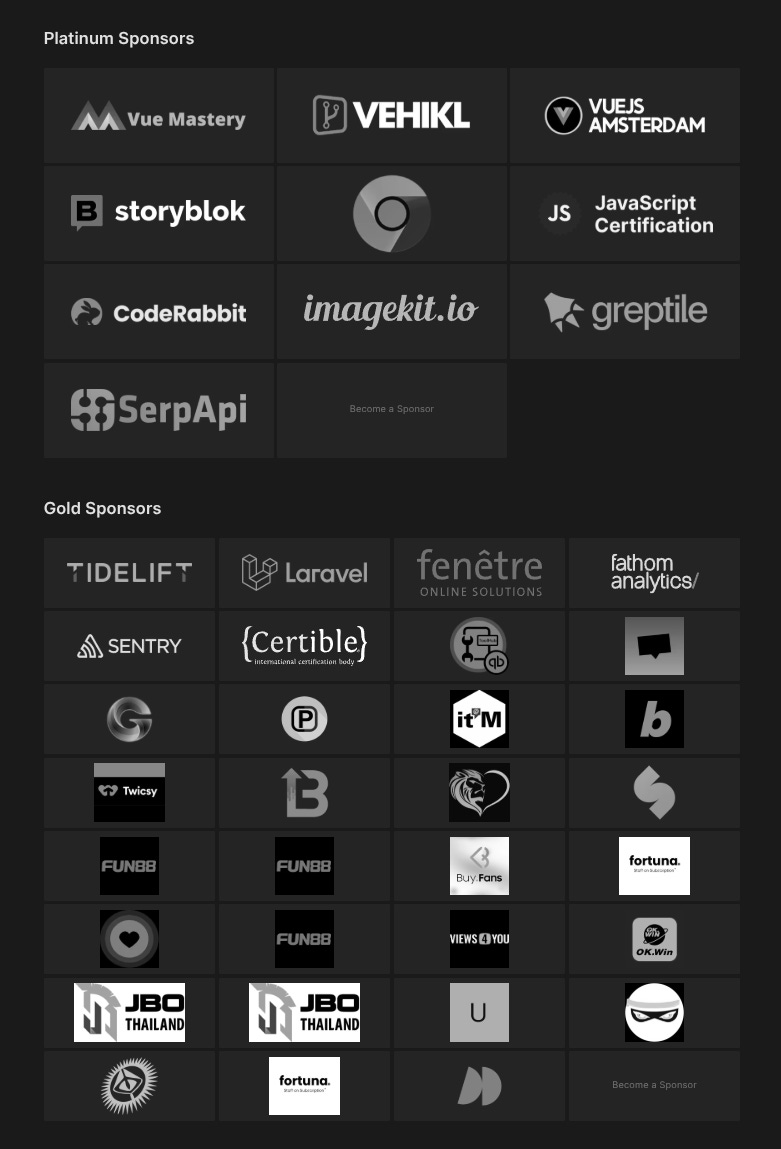
The difficulty is converting widespread appreciation into recurring commitments.
GitHub tries to facilitate this:
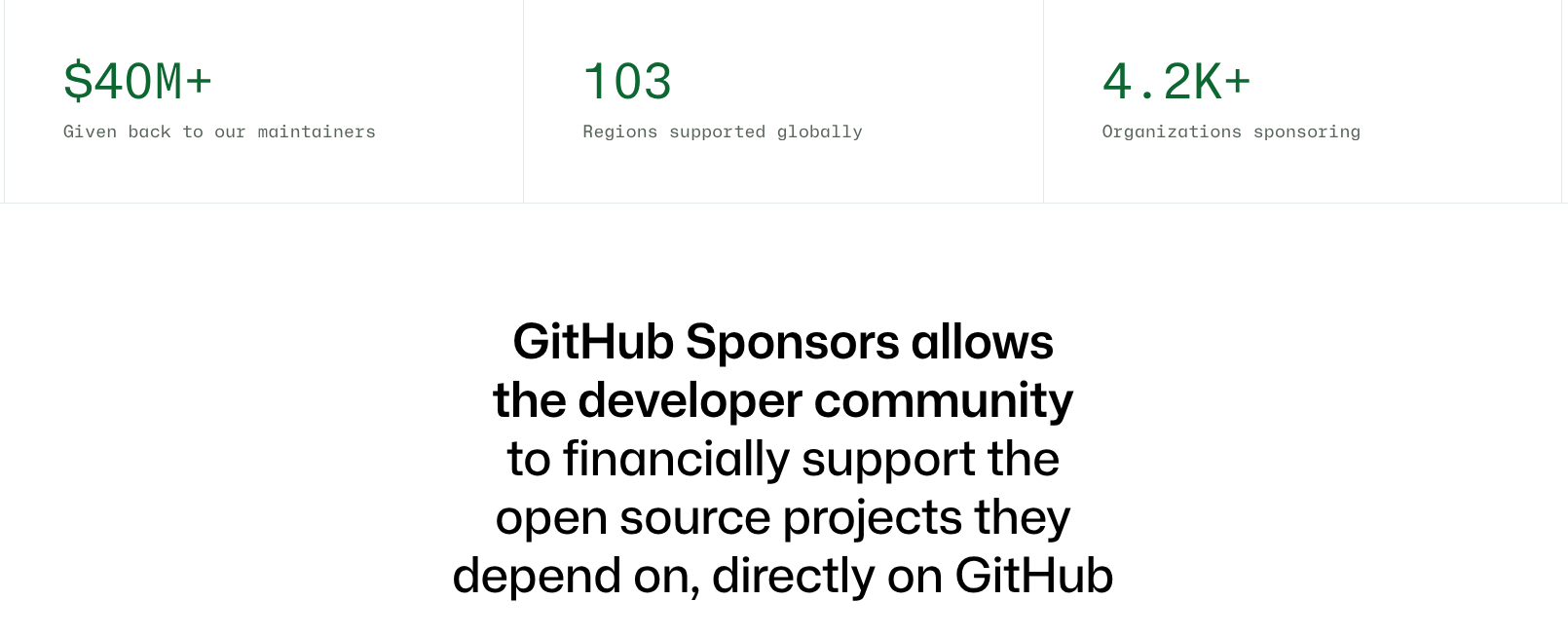
Sponsorship asks someone inside a company to fund work that they depend on and benefit from. GitHub Sponsors and Open Collective handle the payment side, so the mechanics are easy enough.
It can build a revenue stream that keeps a project going, but it won’t scale into a business.
Paid companion products and extensions
A paid companion product gives people a separate purchase that becomes useful because they already use the free project. That might be deployment tooling, an administration interface, or a library of finished components.
Laravel Nova: A commercial administration panel for Laravel applications.
Tailwind Plus: Paid UI components, templates, and a UI kit from the Tailwind CSS team.
SQLite Encryption Extension: A paid extension that adds encrypted database support to SQLite.
The good part is the range of companies it supports. A focused tool doesn’t need an enterprise sales team to justify its existence. And starting with a companion product doesn’t impose a ceiling: Laravel’s business attracted a $57 million investment from Accel 🚀
So which one is best for your project?
The best approach is to work out which problem your project creates or exposes, who specifically owns that problem, and whether that person has a budget.
Four questions that will help steer you:
Who’s responsible when it spreads? One developer installs it and nothing breaks. Twenty people use it and someone has to answer for who can access what. That someone is usually a platform lead or a security engineer, and they didn’t choose the tool. That’s who open core sells to.
Who’s on call? Backups, upgrades, scaling, security patches. If that work is constant and grows with usage, managed hosting and support start to make sense. If the only hard part is installing it, people will just install it. And if the endless work is yours rather than theirs, you’re looking at sponsorship.
Who does the licence block? Someone wants to ship your code in their product and their lawyer has said no. That’s a dual licensing deal, and it’s a small, specific group of buyers. Blocking competitors is a different thing and it doesn’t make anyone want to buy.
What do they need next? Your project works, and now they want an admin UI, or deployment tooling, or components they'd rather not build. That's a companion product. It works best when the thing they want was never going to live in the project anyway.
Whatever you land on, you need to be clear about who is buying, what problem they have, and why the FOSS version doesn’t already solve it.
And don’t forget, it probably has a shelf life. Our initial model at CloudBees got steadily eaten by upstream Jenkins and Kubernetes. MinIO’s answer eventually required taking something back that people already had which didn’t end well. The line you draw between free and paid isn’t a decision you make once, it’s something that needs monitoring and revisiting periodically.
Open source can get you adopted, but doesn’t get you paid. That part you have to design.

Book a free 1:1 consultation call with me - I keep a handful of slots open each week for founders and product growth leaders to explore working together and get some free advice along the way. Book a call.
View the State of AI Search for Dev Tools 2026 benchmark report - 126,814 citation records across 1,075 representative tool-evaluation scenarios, 43 developer-tool categories, and five AI search platforms
View your free public Dev Tool AI Market Presence Report - 500+ dev tools across 47+ verticals and growing, all in the Dev Tool AI Search Landscape.
Sponsor this newsletter - Reach over 11,000 founders, leaders and operators working in product and growth at some of the world’s best tech companies including Paypal, Adobe, Canva, Miro, Amplitude, Google, Meta, Tailscale, Twilio and Salesforce.
Thanks again to our sponsor: Crossbeam
