



Onboard new users in half the time.
Jimo puts an onboarding agent inside your product: new users gets step-by-step guidance on their own screen, tailored to them, fitted to the interface in front of them. It answers from your docs and can act. Zenchef and AB Tasty run it today.
It usually starts with frustration.
Teams complaining about other teams. Not delivering what was expected. Not delivering fast enough.
And “not fast enough” can often be explained by the other team not deeply understanding the assignment the way the first team did.
You may have been lucky enough to have worked in companies where alignment is strong. There’s a shared sense of ownership, little faction-type behaviour, few silos. And you may also have had the misfortune to work in environments where you feel a sense of division.
It’s a people problem. Or is it?
Most leaders in that spot are unsure what went wrong. They’re puzzled, frustrated and looking for answers. And they tend to assume it’s a people or skill problem.
I get why. People and skills are the root cause of a lot of problems in product and growth, so it’s natural to lean that way when you’re trying to pin a root cause on the symptoms.
In all fairness, there’s probably some of that going on alongside. You could argue that a lack of curiosity to fill in the gaps, or an inability to spot blind spots, are people problems. Skill issues. They do contribute. In teams where folks are less willing to leave blind spots be, more attuned to something not quite being right and keen to dig into it, drift gets caught in its early stages, or before it happens at all.
But if you work on the assumption that teams are fallible, there will always be situations like this, and always the opportunity for drift. So it feels lazy to pin the blame on people or their skills.
Even when those are the underlying cause, the leader should shoulder at least some responsibility. They created an environment where divergence could happen, or accepted that it would, and didn’t put the mechanisms in place to find, spot and course correct it.
Birmingham to London
What’s going wrong has a name. Alignment drift.
It’s when one person or team has a set of assumptions and an understanding that differs from another person’s or team’s. At the beginning of a project the differences might be extremely tiny. But the further along the project goes, the more decisions get made on those original assumptions, and the more new assumptions come in. The teams get further and further apart. They should be heading in the same direction, but they end up not.
Picture two teams setting off to travel from Birmingham to London. One ends up in Bristol. The other ends up in Edinburgh.
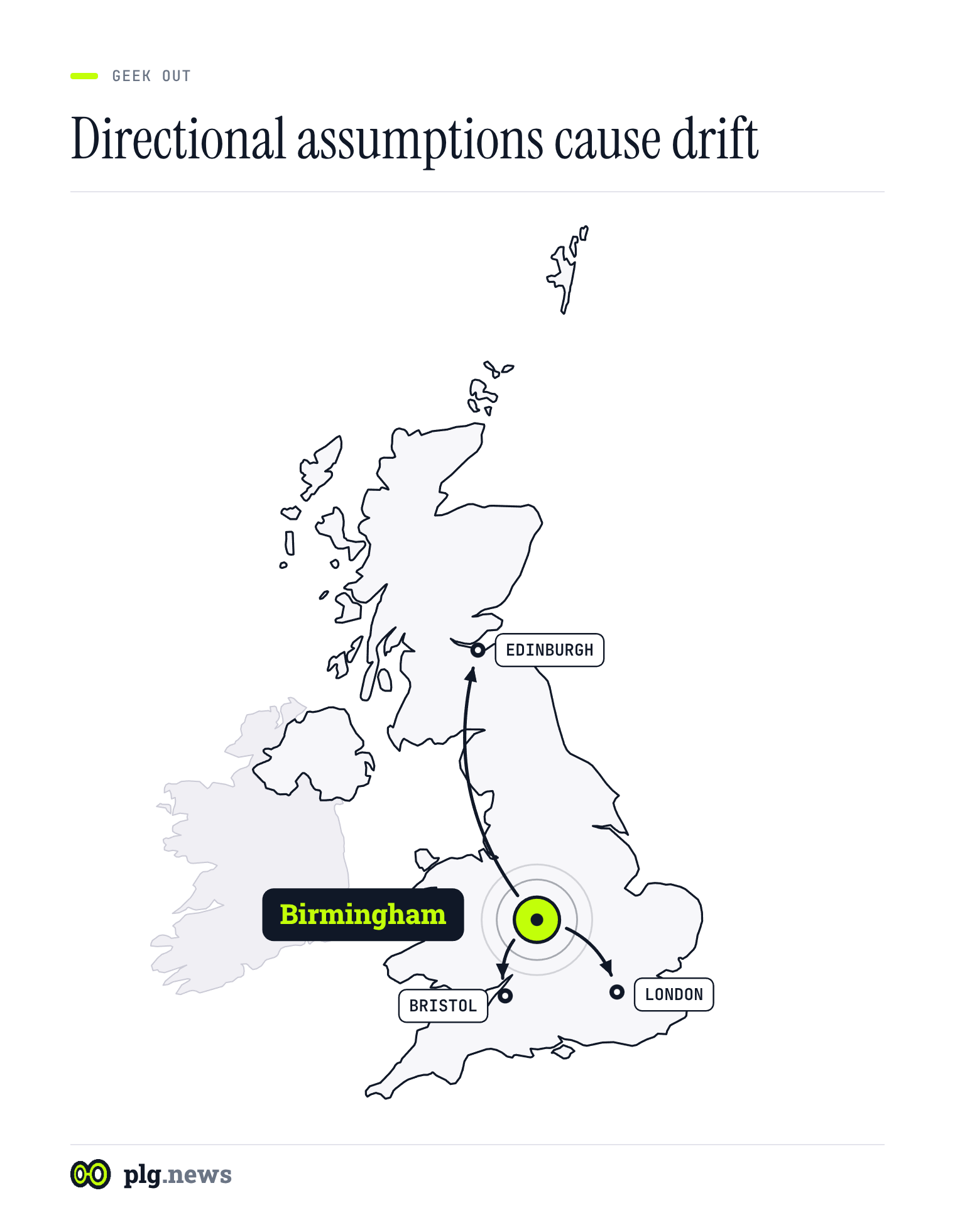
You’ll never have complete alignment on any given day, and that’s OK. But the impact gets exponentially worse the longer it’s allowed to go on. Over a short period those subtly different directions are inconsequential. Over a long one, they’re the gap between London and Edinburgh.
The problem is people don’t realise they’re heading in subtly different directions.
You can feel pretty confident that you’re on the same page. You hear the similar words and phrases in meetings, but people actually mean subtly different things.
AI makes the drift happen faster
This isn’t a new problem of course. As leaders we’ve needed to help keep teams heading in the same direction for as long as there have been teams. But AI is making it a more intense, frequent problem.
In a lot of teams, unfortunately, people are delegating to AI and not doing some of the thinking and communication they previously would have done. And AI lets them move faster, so the divergence happens faster too.
The more genuine thought you put into something, the deeper your understanding. The more you delegate to AI, the more you move away from that thought process. You become a consumer of the model’s output. When you do, you get further from the actual problem you’re trying to solve, and it gets harder to spot, or feel, when you’re moving in a direction that isn’t aligned with others.
Build in checkpoints
So you need more points of alignment along the way, to micro-adjust.
Early on, and at regular points after, ask the teams working together on a programme what it is you’re trying to do. Have them explain it in their own words. First the overall programme of work. Then what each team is doing to contribute to it, again in their own words, with the other teams challenging and picking into it until what’s communicated is well understood and agreed.
The complementary part is the unknowns. What don’t we know yet? What are our assumptions? What gaps are we filling in, and how are we filling them? What are we going to do to find out, and flesh those assumptions out with real detail and real contextual understanding? Teams that align on that give drift less opportunity.
The simplest safeguard of all is writing it down. Often the drift happens because understanding is implicit, not explicit. When it’s only in your heads, misalignment feels inevitable. So just make it explicit.
“So, more meetings?” No. What matters is how you spend the time in the syncs you already have. None of this implies extra meeting overhead, just more efficient use of the time you’ve already got. And if it does take extra time, it’s time well spent. You’re preventing a lot of wasted time down the road when you’d have to course correct.
“Won’t everyone just nod along?” Only if you let them. This is a great opportunity for product leaders to lean in with curiosity and facilitation. Pick arguments apart. Dig in. Use the five whys, or something similar, to tease out a solid understanding instead of taking the first thing people say at face value.
And share context. More than you think you should. It's almost always net positive.
AI as an excellent aid
The same tool can work the other way.
Used responsibly, AI can absolutely help you understand specific domains, situations and contexts. It doesn’t have to leave you with more gaps you’re less intimately familiar with. It can give you a deeper understanding of a problem space, so fewer assumptions get made, there are fewer gaps to fill, and there’s less drift.
The people who close gaps well don’t fill them by assuming. They dig in and try to understand the situation better. Sometimes that means talking to people and spending time thinking for yourself, but AI can be an excellent aid.
One of my favourite versions of this is using the ask-question tool in Claude Code. Use the model as a thought partner. Describe what you’re working on, the goals and outcomes, the current status. Have it challenge you and tease out the things you might not be thinking about: the gaps, the assumptions. Have it enumerate them all and help you fill them in.
You can’t have all the answers on day one. Where it’s too early to fill a gap, state it clearly and document it.
LLMs are excellent at finding those holes and early assumptions that people need to be on the same page about. A dedicated skill that takes something like a product one-pager as a starting point and grills you on each initiative can work wonders.
Monday morning
If you’ve got a programme running across teams right now, start here.
Ask each team what the perfect outcome looks like. What do we deliver as an overall programme, and what’s our team’s contribution to it? Get those answers in detail. Circulate them across the teams, and have the other teams give feedback.
Everyone thinks they’re driving to London. Help make sure they get there.
Until next time!

Book a free 1:1 consultation call with me - I keep a handful of slots open each week for founders and product growth leaders to explore working together and get some free advice along the way. Book a call.
View the State of AI Search for Dev Tools 2026 benchmark report - 126,814 citation records across 1,075 representative tool-evaluation scenarios, 43 developer-tool categories, and five AI search platforms
View your free public Dev Tool AI Market Presence Report - 500+ dev tools across 47+ verticals and growing, all in the Dev Tool AI Search Landscape.
Sponsor this newsletter - Reach over 11,000 founders, leaders and operators working in product and growth at some of the world’s best tech companies including Paypal, Adobe, Canva, Miro, Amplitude, Google, Meta, Tailscale, Twilio and Salesforce.
Thanks again to our sponsor: Jimo, the onboarding agent that guides every user inside your product.
